It's a simple question. Sure, we're usually not supposed to look at the Sun, but why the special glasses? Why can't I wear normal sunglasses to look at an eclipse? What's wrong with squinting? Is the "Big Eclipse" industry just trying to sell more glasses? If you can take them off during totality, why not at 99%? It doesn't hurt to look at a partial eclipse, how bad could it really be for my eyes? Why did my optometrist say I have retinal scarring and not burning?
In this article we'll be reviewing astrophysics, photonics, and retinal biology to explore what exactly happens when you look at the Sun, what makes an eclipse different, and what exactly eclipse glasses do.

Disclaimer
Since this article concerns eye safety, my editor tells me I need to include a disclaimer. I'm not an optometrist, and even if I were an optometrist (which I'm not) I wouldn't want people getting eye safety advice from anonymous online sources. This article isn't intended to make any unusual claims about eye safety for eclipse viewing. You should wear approved eye protection any time you want to look at the Sun. I have no doubt that there are some medical conditions that could require additional consideration over what's discussed in this article. Consult a licensed optometrist for recommendations on eye safety. I'm not even an unlicensed optometrist, much less a licensed one.
Light and Electromagnetic Waves
In order to approach this question, we're going to need to know what light is. What we perceive as light is part of a broader phenomenon called electromagnetic radiation, which includes electromagnetic waves. Electrical fields and magnetic fields interact with each other in a number of interesting ways which are described quite well in Maxwell's equations. The important thing for this discussion is that changing electrical fields can produce magnetic fields and changing magnetic fields can produce electrical fields. This leads to a well-balanced relationship in which electrical and magnetic fields can produce a chain reaction[^1] where they alternatively drive each other. This alternating mechanism resembles a wave in both the electrical and magnetic fields, leading to the term "electromagnetic wave" and the rate at which the reaction propagates through space is what we refer to as the speed of light. The frequency and intensity of the wave are dependent on the manner in which it's generated.
I know I'm just a couple paragraphs into an article about eye safety, but unfortunately for everyone involved I can't leave well enough alone and am going to have to interject about wave-particle duality. While light often seems to behave like a wave, it also sometimes seems to behave like a particle. There's a famous experiment eponymously involving two slits which demonstrates that depending on the experimental setup, light may appear more wave-like or more particle-like. We've named light's particle-like personality the photon and it can be thought of as a particle which embodies a small packet (a quantum) of electromagnetic energy, with the energy of each photon related to the frequency of the wave-like personality. I'll be using the terms "wave" and "photon" according to whichever model of light's behavior is more applicable to the context in which it's being discussed.
There are a few ways to generate these waves, some of which are going to require some (more) background in quantum physics. But before we get there, I want to make sure you know what to expect.
[^1]: Yes, calling this a "chain reaction" ascribes a causal relationship which may be a little bit of a weird topic in this context. I've filed this sin right next to the use of the term "spin" in relation to particles without physical volume.
Quantum Physics Primer
Analyzing systems closely is always interesting. When you really start pushing the envelope and digging into why a system works the way it does, there are basically two ways it can go. It could be "turtles all the way down" (i.e. the system works the same way no matter how closely you zoom in) which might be intuitive but isn't going to give a satisfying answer to why it works that way. The other possibility is that looking deep enough reveals that at some point things start getting weird.
Imagine what it might be like for characters from "The Sims" that have become sentient and inquisitive about the nature of their universe. At first glance the world looks like what they're used to: objects moving around, appearing/disappearing randomly, etc. Maybe, if they're lucky, they may gain insight into the fact that if you look close enough it's actually all just tiny pixels that are changing color. This discovery alone would be extremely alien to them, but if they keep pushing and try to discover why the pixels are changing color then they're in for a challenge. The true reason the pixels are changing color (a device in the physical world called a video card) is absurdly complex, operates according to physical rules they have no insight into, and has no apparent reason for existing in the first place. They're prone to develop other theories that explain what they know about pixels which appeal to their concept of what "makes sense" much more strongly than what's actually true. The arrival at the correct explanation would be serendipitous, if possible at all.
Even if they somehow discovered the video card, they'd only have found another layer of the problem. The card itself is made of electronic components, which are made of materials, which are made of atoms. Every answer opens up the possibility of another question.
That's basically where we are with chemistry. We've discovered that the universe isn't simply "turtles all the way down": matter has an underlying structure, and when we examine it closely enough we encounter behavior that defies our everyday intuitions. We've developed remarkably successful models for explaining and predicting what we observe, but questions about why reality works this way, and what we might find by digging even deeper, remain open for conjecture. Some of the models that I'll be discussing in the next section (and previous section, I suppose (sorry)) can be very unintuitive, and it's easy to interpret an affront to intuition as a signal you're misunderstanding something. As you continue reading, just keep in mind that this subject seems unintuitive because it is unintuitive. Keep an open mind; we're not in Kansas anymore.

The Structure of an Atom
You can think of atoms as being composed of a nucleus and electrons. The nucleus itself is composed of particles called protons and neutrons. Protons have an electrical charge which is equal to and opposite of the charge of an electron, and is arbitrarily referred to as "positive" while the charge of an electron is "negative". Neutrons, as their name suggests, are neutrally charged. Protons and neutrons nominally have the same mass while electrons are much lighter.
The number of protons an atom has dictates what element it is. An atom with one proton is hydrogen, an atom with two is helium, an atom with ninety-two is uranium, etc. The total number of protons and neutrons dictates the isotope of the atom, where the isotope uranium-235, for instance, has 92 protons (because it's uranium) and 143 neutrons (235 minus 92). uranium-238 has 146 neutrons and is much more common. The process of uranium enrichment, which is quite difficult and is a major hurdle in developing nuclear capabilities, is the separation of uranium-235 from the more abundant uranium-238 to use as nuclear fuel.
The electrical charge of an atom is related to the number of protons minus the number of electrons. An atom with the same number of electrons as protons is neutrally charged, while an atom with more or less electrons has a negative or positive charge respectively and is considered an ion.
In terms of geometry, the nucleus is quite small compared to the spatial extent of the atom even though it contains the vast majority of the atom's mass. Electrons are often thought of as "orbiting" the nucleus, but that's not entirely accurate. From what we're able to observe, the electrons of an atom appear to exist in somewhat nebulous clouds in the vicinity of the nucleus. The clouds are probabilistic models of where an electron could be if its location were measured and depending on how you interpret quantum mechanics, electrons may not even have a location until their location is measured. The important thing about these clouds (fossilically called orbitals) is that they're associated with the electron's energy level, and when electrons gain or lose energy they move from one orbital to another with a different energy level.
Interestingly, the allowed energy states of a bound electron aren't a continuous spectrum. Electrons bound to atoms can only occupy certain allowed energy states rather than an arbitrary continuum of energies. Transitions between these states involve specific amounts of energy, meaning that if an electron gains or loses energy it does so in discrete steps corresponding to the energy levels of the orbital the electron transitioned to and the one it previously occupied. A common means by which an electron can gain or lose the energy needed to transition to another energy level is by absorbing or emitting light. Because a photon's energy is proportional to its frequency, the frequencies of light emitted by an object can be revealing of the electron configuration of the atoms that make it up, and consequently the elements it's composed of.

Electrons also play a critical part in the bonds between atoms that form more complex molecules, so incident electromagnetic radiation's effect on electrons can lead to effects on molecular structures. Powerful sources of electromagnetic energy can cause molecules to break apart or change form, which as we'll see later is related to the mechanism by which you can perceive light and by which your body can be damaged by the Sun.
In general, higher-frequency (and therefore shorter wavelength) radiation is more likely to cause molecular damage than lower-frequency radiation of similar intensity. This is why ultraviolet (UV) can be so hazardous: it's a higher frequency form of radiation than visible light. While visible light ranges in wavelength from 750 nm (red) to 380 nm (violet), UV is divided into three spectra: UVA, UVB, and UVC. UVA ranges from 400 nm to 315 nm, UVB ranges from 315 nm to 280 nm, and UVC ranges from 280 nm to 100 nm. UVC radiation is almost completely absorbed by Earth's atmosphere which is lucky since it's extremely hazardous to organic life. We use artificial UVC sources for sterilization because of how good it is at killing things. UVA and UVB both naturally reach Earth's surface, and of the two UVB is generally the more hazardous.
The Generation of Electromagnetic Waves
With that background, we can find that there are a few ways to generate electromagnetic waves:
- Induce an oscillating electrical field in a conductive antenna, which radiates EM waves with the frequency of the oscillation
- Excite an electron from its natural energy level to a higher energy level and allow it to fall back to its natural energy level, which emits a pulse of light corresponding to the energy that was released by the electron
- Any object hotter than absolute zero radiates a portion of its thermal energy as light. The spectrum of light radiated depends on the temperature, but in general as the temperature gets hotter the frequency of radiated light gets higher
This information will help in understanding the next critical topic of this article:
The Sun
The Sun is a star, and it's noteworthy for its proximity to Earth, which is where most humans live. It's so close to Earth that it looks and feels very distinct from other stars to an observer on Earth, but that's what it is. In fact, aside from its notable location it's a fairly typical star. Its mass (1.989 nonillion kilograms) and surface temperature (5,800 K) categorize it solidly as a "main sequence" star. Specifically, it's a class "G" main sequence star, where the classes go from "O" to "M" in the eclectic order of "O", "B", "A", "F", "G", "K", "M"[^2] which classify main sequence stars of decreasing mass, surface temperature, and rarity. Although "G" is near the middle of the series, "M" by far encompasses the most stars in the observable universe. So I guess in a way the Sun is a little bit unusual; it's just a hair less common than blue eyes in humans.
Because the matter composing the Sun is exceedingly hot, it exists in the notoriously neglected[^3] fourth state of matter: plasma. One of plasma's defining features is that it's so hot that electrons become unbound from the atomic nuclei. Since the electrons are unbound, their emission of light isn't limited to the discrete wavelengths one would expect from ordinary atoms. Instead, the electromagnetic energy that's emitted includes a broad, continuous spectrum which is primarily driven by "black body radiation". Black body radiation is the name for electromagnetic energy which is radiated by objects due to their heat. Cooler objects, like biological lifeforms, emit a low-energy spectrum primarily in the infrared band while hotter objects, like fire, emit higher-energy visible light.
Very hot objects, like the Sun, emit a broad spectrum of electromagnetic waves primarily ranging from less than 100 nm to over 2500 nm. This includes infrared, visible light, and ultraviolet. Most of the energy that makes it through Earth's atmosphere ends up being in or near the visible spectrum, but the other portions make their way through as well and do all kinds of interesting things like heat up asphalt, help plants metabolize carbon and water, irritate astronomers, cause cancer, and denature chemical pigments (to name a few).

[^2]: Okay, there actually is a reason for this. Back before people knew why stars had different properties, they were categorized by letter from A to O in order of the strength of their hydrogen lines. It was later discovered that the hydrogen strength wasn't actually related to the composition of the star, and was a symptom of the star's temperature. Cold stars didn't have enough energy to excite electrons to produce the lines and hot stars ionized the hydrogen completely which also decreased the strength of the lines. When all this was discovered the categories were rearranged in order of temperature and consolidated, which is why "A" ended up in the middle (the medium-temperature stars had the strongest hydrogen lines). This arrangement had the side effect of forcing astronomers to adopt the slightly-too-risqué pickup line of "Oh, be a fine guy; kiss me", exacerbating the social stigma of the field.
[^3]: The fact that it's "notoriously neglected" actually makes it less neglected than the many "obscurely neglected" states of matter which are through no fault of their own unrelated to the topic of this article.
Anatomy of the Sun
The Sun has several internal layers, but for the purposes of this discussion all that really matters are the photosphere and the corona. The photosphere is the visible surface of the Sun which is what's emitting the strong light we associate with the Sun. The corona is essentially the Sun's atmosphere which isn't typically visible with the naked eye since it's much more dimly lit than the photosphere. The corona itself has several layers (not really layers since they overlap, but that's the standard term for them):
- The K-Corona (Kontinuierlich): This layer's spectral emission is caused by sunlight from the photosphere scattering off free electrons in the plasma composing the layer, making its emission spectrum continuous. This layer is around 5-10 orders of magnitude dimmer than the photosphere and extends outward to around 4 solar radii.
- E-Corona (Emission): This layer includes highly ionized heavy atoms which emit light, so its emission spectrum is a complex combination of specific frequencies. It's much dimmer than the K-corona at 7-10 orders of magnitude dimmer than the photosphere and extends out to around 2 solar radii.
- F-Corona (Fraunhofer): This layer is composed of dust particles orbiting the Sun which reflect sunlight from the photosphere. It ranges from 7 to 10 orders of magnitude dimmer than the photosphere and extends out very far, more than 10 solar radii. Close to the photosphere (within around 2 solar radii) it's outshone by the K-corona.
There's also T- and S-corona layers, but they aren't very relevant to this article. The photosphere, K-, E-, and F-coronas are the most critical to understand when discussing the Sun's light.
Of course, understanding the light that the Sun produces is useful, but if we want to understand its effect on our eyes we're going to have to get into some biology.
The Human Eye
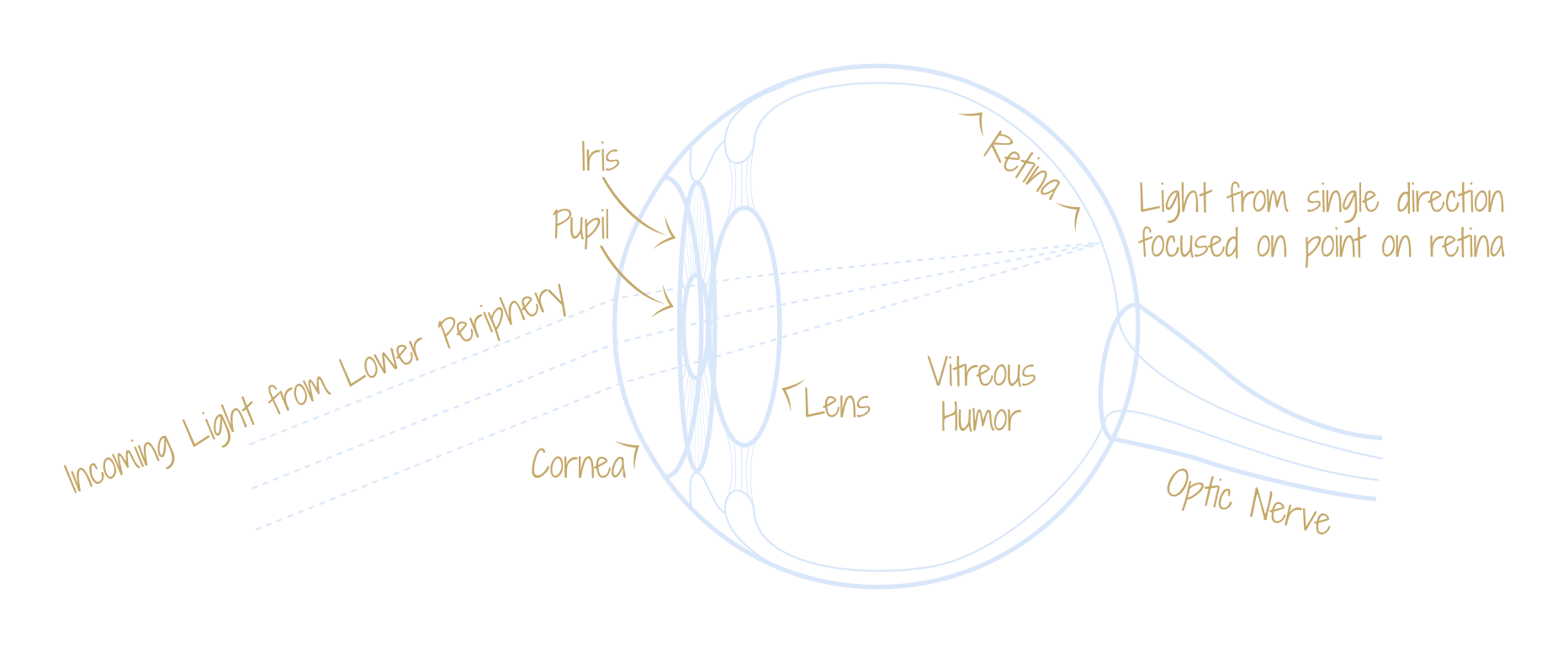
A human eye actually works a lot like a camera. It's primarily composed of a large mostly-opaque chamber with a hole in the front for light to pass through, a lens to project the light onto the back of the chamber, and an array of photosensitive modules lining the back which react to the projected light and produce an image. The opening even has an adjustable aperture to control how much light is allowed to enter the chamber. There are also a few differences:
- The hole in the front of the chamber is called a pupil and it's the dark spot in the middle of your eye. The radius of the hole can be adjusted by the iris, which is a washer-shaped organ surrounding your pupil and is what gives your eye its color. It contains small ring-shaped muscles (pupillae) which can contract to make the opening smaller,[^4] and small radially positioned muscles which can contract to pull it wider again. The iris doesn't react to light by itself, instead its contractions/dilations are unconscious brain-driven responses to the level of light perceived by your retina. The iris itself also isn't fully opaque; some light passes through even the "blocked" portion. The translucency of the iris is related to the amount of melanin it contains, which is the same thing that decides eye color. This is why people with blue/green/gray eyes are usually more sensitive to light than people with brown eyes.
- The eye's analogy to a camera lens is actually composed of two parts: a cornea, which is the little lump on the surface of your eye in front of your pupil and which focuses light through the pupil into a second part, unimaginatively called the lens. The cornea is a fixed shape which coarsely focuses the incoming light prior to entering the pupil and the lens has an adjustable shape which can be manipulated by tiny[^5] muscles to dynamically perform fine focusing. Some visual focusing issues can be mitigated by adding additional lenses in front of the cornea, which is what contact lenses are.[^6]
- The chamber is filled with a clear jelly-like substance called the vitreous humor and has a ton of little veins and nerves carelessly routed through it.
- The photosensitive array in the back of the chamber is your retina, and it's composed of a mixture of millions of cells called rods and cones. Rods are sensitive to the intensity or brightness of light while cones are sensitive to spectral ranges corresponding to individual colors, specifically red, green, and blue. You have a lot more rods than cones, and the cones are primarily clustered in the center of your retina in a region called the macula (responsible for your high-resolution central vision) and particularly in a smaller region in the middle of the macula called the fovea (responsible for your higher-resolution, central-er vision). This arrangement means that humans can't actually see much color in their periphery.
As a side note, this geometry basically means that when you look into someone's pupil you're basically seeing a ~1 millimeter section of their retina which has been magnified by the cornea. The reason it usually appears black is that it's unlit unless there's a light source very closely aligned with your viewing angle. That's exactly what a camera flash does, which is why flash photography often makes people's pupils appear red: that's the color of the retina.
Rods and cones both contain a molecule called 11-cis-retinal[^7] which transforms into all-trans-retinal upon absorption of light. Depending on the type of cell (rod or one of the three cone types) the molecule is associated to one of four types of opsins, which are proteins that bind to the retinal and affect its response to specific frequencies of light and amplify its chemical response into an electrical signal which goes to the brain. After the molecule has been converted to all-trans-retinal, it's converted back into 11-cis-retinal through a surprisingly complex chemical process[^8] called the retinoid cycle which is outside the scope of this article.
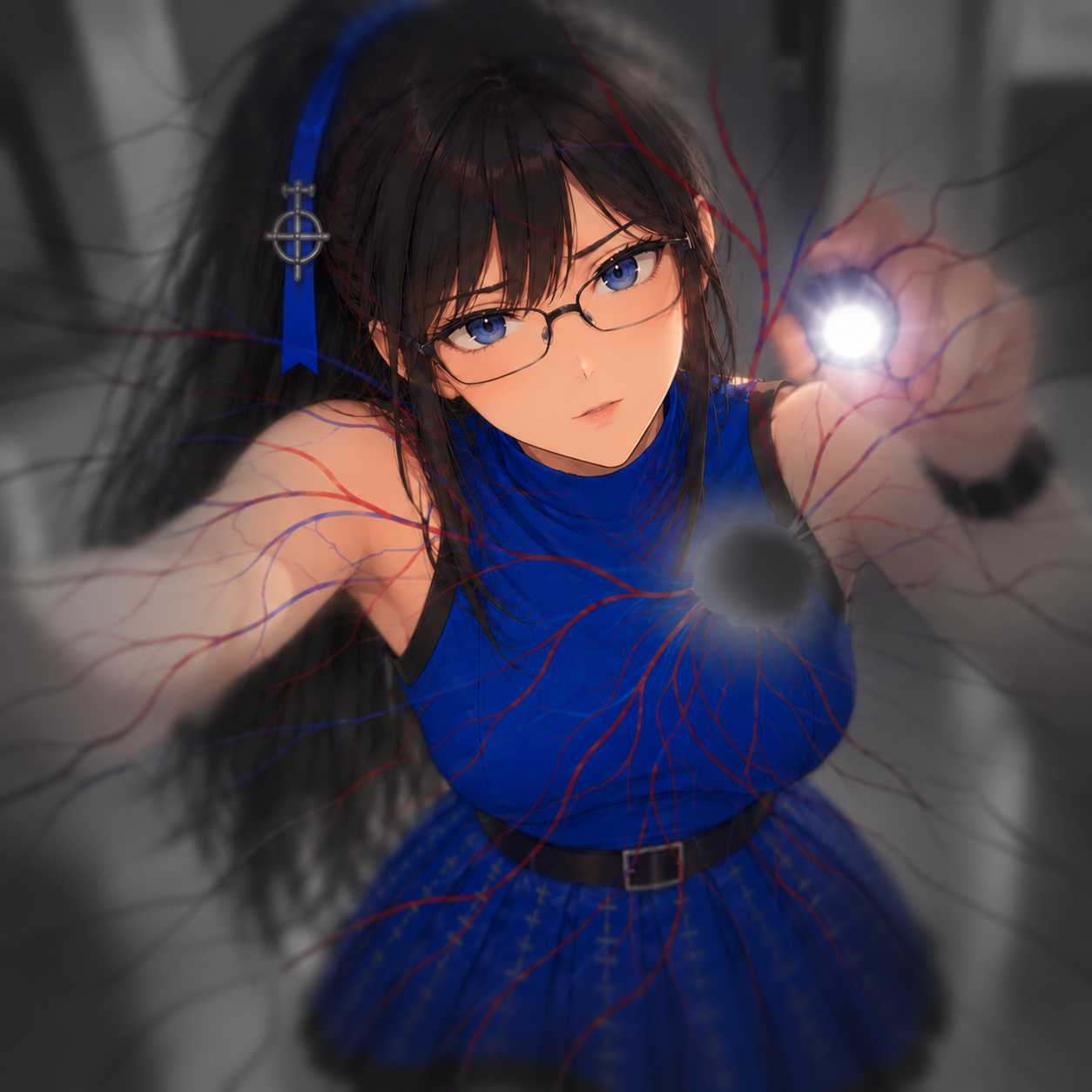
All of this means that the overall image that your eye is actually producing is very different from what you might expect from your experience of sight. The imagery formed on your retina is occluded by veins and nerves, mostly colorless on your periphery, and has a "blind spot" a bit to the side of center due to the location of your optic nerve.
For a long time, it was quite difficult for people to intuitively understand how a brain could construct such a clear sight experience from this far-from-ideal source image, but with the modern popularity of AI imagery models it may not be a far stretch to imagine that a sufficiently sophisticated bundle of neurons could accomplish the task. In your brain, this is accomplished primarily by your occipital lobe. There are a few interesting activities you can do at home like the "Purkinje Tree" experiment or Amsler grid eye tests which can trick your brain into allowing you to perceive these imperfections; it's quite unsettling.
[^4]: If you've ever accidentally removed a chainsaw's clutch guard without disengaging the chain brake then you have some experience with this mechanism.
[^5]: You may be noticing that a lot of these components are small. There's actually an anatomical reason for this: the eye is small, so everything inside it has to be small too.
[^6]: Or, in my case, glasses. I've never been a fan of contact lenses. I'm a human, which means I have an aversion to things touching my eyes.
[^7]: Yes, actually this is related to the topical cosmetic products retinol and retinal. That doesn't mean you should put them in your eye, but I'm not an optometrist so don't take my word for it.
[^8]: I guess I shouldn't say this. I tend to find biochemistry "surprisingly complex", so maybe it's on me for being so easily surprised.
Damage Mechanisms
From the information in the previous section, we can find that there are a few points at which strong light may damage the eye. As light enters the eye, it first passes through the cornea. The cornea filters a lot of the particularly harmful spectra of light, like UVC, and in doing so absorbs a fair amount of light itself. From there the light passes through the pupil, which is a gap in the iris rather than a biological structure and cannot be damaged by light. Next it passes through the lens, which is made up of cells and could be damaged by intense light. Last, the light gets focused on the retina which is made up of light-sensitive cells and is similarly vulnerable to damage. During most of the transit through the eye the light is also passing through the vitreous humor, but that's mostly water and contains very little complex organic matter which makes it resistant to damage. Of course, the sensitivity of all of these different components to various spectra of light is a complex topic, but it's something that's been studied extensively.
If you take a look online, you'll find a number of optometry journals and blogs saying that high-frequency blue light and UV light are the spectra that are most damaging to the eye. I hate to disagree with what appears to be professional optometry publications as an anonymous blogger, but I feel like I should clarify that that's not entirely complete. I happen to know firsthand that high energy light in other wavelengths (e.g. infrared or red lasers) can also damage the eye, and above-UV spectra such as X-rays and gamma rays also carry the risk of eye damage. To be fair to optometrists, they may be considering my additions to be mitigated by a couple factors:
- Unfortunately, most people don't get a lot of firsthand experience with high-power lasers, X-rays, and gamma rays outside of professional settings. None of those phenomena occur naturally in the troposphere in the same way that visible and UV light do.
- Fortunately, most people have at least a vague idea that those things are dangerous, while it's less clear if/when the Sun is dangerous. Presumably, seeing lasers do things like cut through metal would prevent most people from thinking "hmm, I wonder if that would damage my eye?"
The obvious counterarguments are that people do interact with X-rays (even if only in the context of medical or security imaging), people do use lasers (just not usually the kind that cuts through metal), and people do interact with infrared light sources powerful enough to harm their eyes (such as from a large fire).[^9]
There are a few different mechanisms by which light can cause damage to the eye:
- Photochemical damage, in which intense high-frequency visible light (blue) and UV light have enough energy to cause an oxidation reaction in the molecular chromophores within the eye. This can result in free radicals which react with neighboring molecules in the cell and could result in the death of the cell.
- Thermal damage, in which the received light is intense and persistent enough to heat the tissue within the eye faster than the heat can be dissipated, eventually leading to burning.
- Mechanical disruption, in which the intensity of a short pulse of light is enough to cause physical cavitation and shockwaves within the eye (remember the metal-cutting lasers? This is where they come in).
Similarly, there are several ways by which these mechanisms can manifest:
- Solar retinopathy: The eye is very good at focusing parallel light rays onto a small area on the retina, so looking at the Sun or into the beam of a laser is basically like frying your retina with a magnifying glass. The retina does not have pain receptors, so you can't necessarily even tell that it's happening. Intense low-frequency radiation (usually infrared or visible light) can cause heating and burn the retina, while higher frequency (mostly blue and UV) light sources in particular can quickly cause photochemical damage, which has the effect of seriously damaging the retina but not necessarily by a "burning" action. It's more like a chemical reaction that's stimulated by the intense radiation rather than heat.
- Photokeratitis: Intense UV light can damage the cornea, causing pain, a "sandy" feeling in the eyes, and temporary vision loss. This is comparable to a sunburn on your cornea.
- Cataracts and macular degeneration: Long-term cumulative UV exposure can cause clouding in the lens (cataracts) and may accelerate the aging of retinal cells (macular degeneration); both of which can lead to blindness.
- Growths and cancer: Prolonged exposure to UV can cause growths and cancer on the surface of the eye.

All of this suggests that it's bad for your eyes to look at the Sun.[^10] UV can be extremely damaging, both instantaneously and cumulatively, but intense infrared and visible light can cause damage as well. It should also be noted that while your iris may constrict naturally to reduce the intensity of light entering your eye, that reflex is stimulated by visible light. High-intensity UV light may be relatively unobstructed by your iris if the visible light in the environment is a lower intensity. It's common to believe that this effect is what makes eclipses so dangerous to look at, but it's not like the Moon is transparent to UV and it has no atmosphere to introduce any frequency-dependent refraction phenomena. In reality the UV light is blocked to approximately the same degree as visible light so an eclipse doesn't specifically stimulate this condition very notably. The more correct explanation is that eclipses are dangerous to look at because the Sun is dangerous to look at, and regular sunglasses aren't protective enough to look at an eclipse because they aren't protective enough to look at the Sun.
In order to safely look at the Sun, whether it's partially eclipsed or not, you'll need to be filtering the light to drastically cut down on the UV intensity to as close to zero as possible and reduce the infrared and visible light significantly as well. This is what the eclipse glasses do.
[^9]: I got nothing for gamma rays. I just wanted to bring them up.
[^10]: It still doesn't explain why my brothers could spend afternoons in competitions to see who could stare at the Sun the longest while I'm the one that ended up with vision problems.
Glasses
There are a lot of different types of sunglasses, but let's start by taking a look at a typical set of high-quality, certified category 3 sunglasses. These sunglasses are designed to be worn for extended periods outside on bright days. A pair of these will block 98 to 99 percent of UVB, 99 to 100 percent of UVA, and 80 to 90 percent of visible light. Most standard sunglasses do not block IR to any notable degree.
Eclipse glasses are around 10,000 times darker and are typically designed to meet the ISO 12312-2 international safety standard. They block over 97 percent of IR and over 99.99 percent of visible light, UVA, and UVB.
Laser safety glasses aren't suitable to protect your eyes from the Sun because they're designed to solve a very different problem. Lasers, by their nature, operate on an extremely narrow range of frequencies. The design goal for laser safety glasses is to block precisely the frequency range at which the target laser operates and nothing else. This makes them very ineffective for blocking broadband radiation like what we receive from the Sun.
Welding masks are a rather complex matter when it comes to eclipse safety; the flashes that they're designed to protect the wearer from are comparable in many ways to the sun's light as seen from Earth's surface. In fact, in some cases welding arcs can be quite a bit worse because they can produce high-intensity UVC which as we discussed earlier can be remarkably harmful. Because welding masks have similar design goals to eclipse glasses, some welding masks are suitable for viewing eclipses. Welding masks are designed in various shades, some of which are more protective than others. So, if the shade is dark enough (typically cited to be shade 14, but don't trust me on that) then the mask's filter is sufficient, but there's another complication that comes with welding masks: some have a feature called "auto-darkening". Auto-darkening helmets have electronics that are able to sense arc flashes and adjust the darkness of the visor quickly enough to avoid damage to the eye, but otherwise be much lighter. This helps welders see what they're doing between flashes (which, depending on the confidence of the wearer, is quite helpful) but relies on complex sensing electronics which are designed for arc flashes and may respond poorly to sunlight. Consider that welding masks often have to be worn outdoors, so some manufacturers may intentionally design the helmet to avoid reacting to sunlight.
I've seen people use welding masks to view eclipses before; I suppose if you spend a lot of time welding it may feel natural/comfortable to wear one, but I never really understood the appeal. Welding masks can feel somewhat isolating and disorienting to wear since they cover your face and limit your field of view. I much prefer the light cardboard glasses. To me it's like the difference between watching a sunset in a covered car vs. a convertible, and eclipse glasses are quite inexpensive, but of course it's a matter of personal preference. It doesn't matter a whole lot anyway since as we'll see you get to take it off for totality, which is the best part unless you're a big fan of crescents.
Solar Eclipses
The Sun is a very prominent feature in our sky,[^11] and more than simply appearing bright during the day it has very significant effects on what we're able to see in both the day and night skies. The Sun illuminates celestial bodies within the solar system quite strongly; the dominant reason that the Moon, planets, and comets are visible to the naked eye at night is because they're reflecting the Sun's light back toward Earth. The effect is strong enough for local planets to appear brighter in the night sky than stars, and of course the reflected light from the Moon is strong enough to make nights feel bright when the Moon is full.
During the day, the Sun illuminates the gases and suspended particles in the atmosphere brightly enough to completely drown out most of the celestial bodies we can see at night. There's an interesting effect that can occur in early dawn or late dusk where an observer on Earth's surface is shadowed from direct sunlight but higher-altitude objects can still be illuminated directly. This manifests with things like clouds, high-flying airplanes, or satellites appearing extremely bright during these periods of the day. There's a particularly interesting phenomenon that can happen in some areas where recently launched rockets release exhaust or vent residual propellant in the upper atmosphere, and when such an event is illuminated in twilight it can appear quite beautiful.
[^11]: Is the "citation needed" joke overdone? I can't tell. I feel like it never gets old.

I bring all of this up because while the geometry of a solar eclipse may be familiar (i.e. the Moon is positioned directly between the Sun and Earth, shadowing an observer on Earth's surface), the phenomenology surrounding its mesmerizing appearance is often overlooked.
In a partial eclipse, the observer isn't fully[^12] in the shadow of the Moon, they're in a region of the shadow called the penumbra. The concept of a penumbra isn't as ethereal as its name suggests. If the source of light that's causing a shadow is large then there's a region around the border of the shadow which is obscured from part of the light source but not the entire source. It's why most shadows have fuzzy edges if you look close enough, and it quite intuitively relates to the fact that when viewing a partial eclipse, only part of the Sun appears obscured by the Moon.
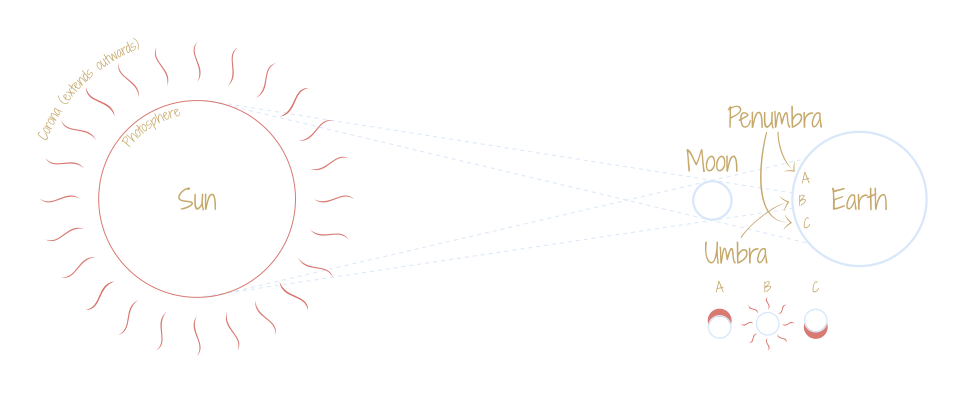
You can estimate the eclipse magnitude at your location by cross-referencing your position with the path/geometry of the penumbra on an eclipse map. The magnitude is the ratio of the Sun's apparent diameter to the apparent depth of the Moon's intrusion at the peak of the eclipse. Keep in mind that:
- the "peak of the eclipse" is an instantaneous event; for the duration of your viewing you'll be exposed to more than that amount of sunlight,
- the percent of the Sun's visible area that's actually obscured (obscuration) is generally less than the diameter ratio (eclipse magnitude), and
- the percentage of sunlight actually getting blocked isn't necessarily equal to the percentage of the Sun's visible area that's obscured by the Moon (obscuration).
Doing some quick napkin math and keeping in mind that eclipse glasses are around 10,000 times darker than regular sunglasses, you would have to view a greater than 99.99% partial eclipse while wearing normal sunglasses in order to have comparable protection from the Sun's radiation and that would only last for an instant. And "comparable protection" is doing a lot of work here as well: eclipse glasses are specifically designed to block the spectra that are harmful so doing math only on their broad "10,000 times darker" metric is not necessarily representative. Even with all that aside, just looking at the numbers it's not surprising that there aren't any optometrists lining up to tell you to relax on the eye protection for a partial eclipse.
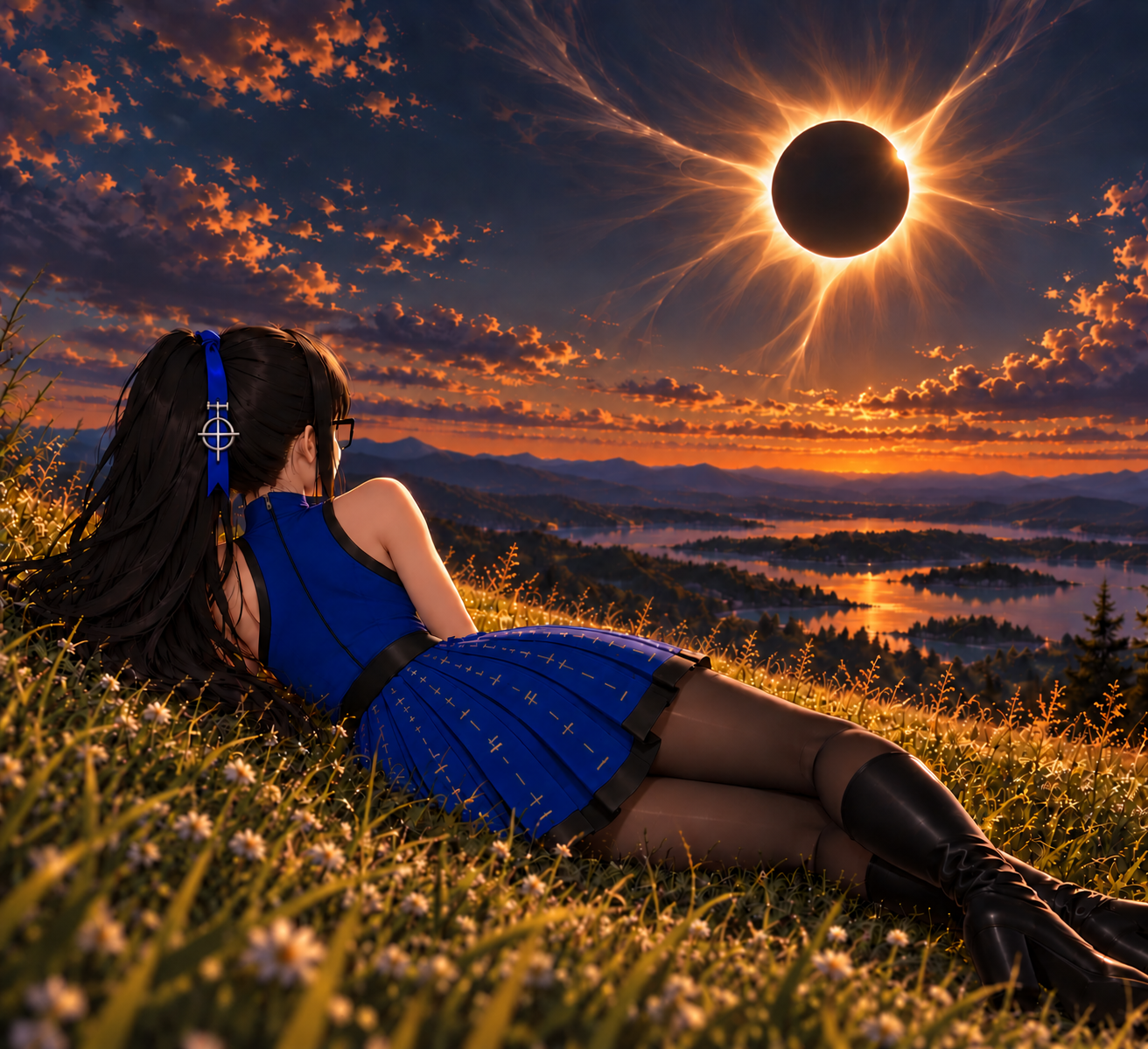
In a total eclipse, the surface of the Sun is completely occluded by the Moon, leaving the observer completely unexposed to direct sunlight and safe from eye damage for the duration of totality. This is similar to the conditions that lead to the twilight phenomena discussed previously, where the absence of direct sunlight combined with the nearby presence of indirect sunlight can lead to spectacular imagery. In the case of a total solar eclipse, the indirect sunlight illuminates the Sun's own outer coronal mass. In lieu of recalling the (admittedly dull[^13]) summary of coronal layers you skimmed through a few sections ago, simply consider that this is an enormous solar atmosphere of plasma whose structure traces the channels formed by the Sun's powerful magnetic field. Due to the specific conditions of a total solar eclipse these features become plainly visible in the sky, leading to a view that's difficult to look away from.
On that note, I'd like to conclude with an anecdote. One of the first old textbooks I remember reading was actually a modest astronomy book from the mid-20th-century. I no longer have it and don't recall exactly what it was called,[^14] but it was one of those old compact hardcover textbooks that I often find are some of my favorites. The book had a section on eclipses and I remember that at one point the author had interjected with a personal aside along the lines of "unfortunately, this author has not yet had the opportunity to witness a total eclipse in person". It gave me a strong melancholy feeling and I resolved to make sure I'd get to see one. It wasn't until 2024, when I fortunately found myself near Ohio,[^15] that I finally checked it off my bucket list. I sincerely hope that the book's author eventually had the pleasure of viewing one as well.
For any readers that haven't yet seen a total eclipse, I recommend you research upcoming eclipses and pick one that you can travel to, even if it's years away. Make arrangements to get there, make sure you have a few options along the path of totality to watch from so you can avoid cloud cover. Pick up some eclipse glasses so you can watch it before totality and once the Sun is completely covered, take them off. I promise you won't regret it.
As long as we're being sentimental, make sure not to forget the most important part of viewing an eclipse: the licensed optometrists you consult along the way.
[^12]: Okay. Yes, the penumbra is part of the shadow and the observer is fully inside it. But I haven't defined penumbra yet and this was the best wording I could come up with as a lead-in. I know it's wrong, but you're going to have to accept my poetic license on this for about 16 words.
[^13]: Alright, listen. It's not entirely my fault. The layers all have terribly uninspired "names", have structurally similar definitions, and there were a lot of wishy-washy numbers that I had to get through because they were important to the topic. It's not my best work but I did what I could and at least kept it short. That's more than I can say for the source material.
[^14]: From online research, I suspect it was "Textbook of Elementary Astronomy" by Ernest Agar Beet, but I'm not able to verify since I no longer possess the book. If you have it, take a look and see if you can find that section for me.
[^15]: Never thought I'd be writing that
Kind regards,
Shannon